



The Graduate Learning Outcomes (CPL) of the Informatics and Computer Engineering Education Study Program (Bachelor’s Program) at UNPAR consist of four aspects, namely Attitude (Sikap), General Skills (Keterampilan Umum), Special Skills (Keterampilan Khusus), and Knowledge (Pengetahuan). These CPLs are formulated by referring to the Minister of Education, Culture, Research, and Technology Regulation (Permendikbudristek) No. 53 of 2023:
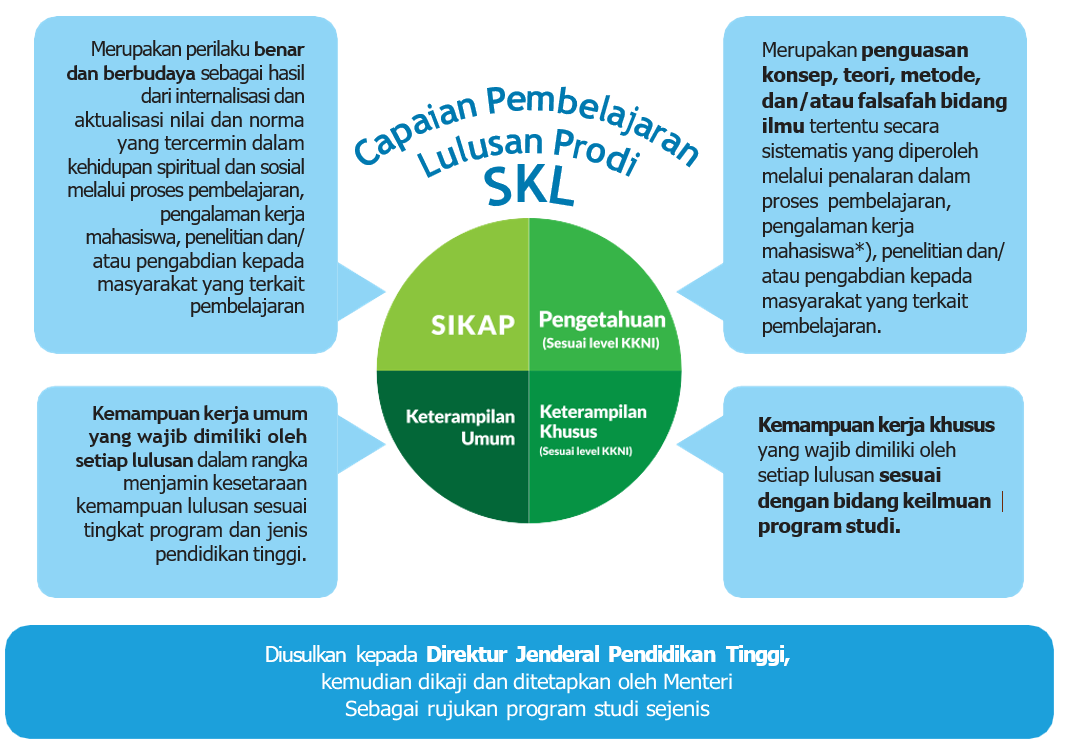
Table of Graduate Learning Outcomes (CPL)
| NO. | CODE | GRADUATE LEARNING OUTCOMES |
|---|---|---|
| 1 | S1 | Able to practice the spirituality and basic values of Parahyangan Catholic University (SINDU), faith in God, and loyalty to Pancasila; |
| 2 | S2 | Applying the spirit of self-reliance, struggle, and entrepreneurship, with responsibility for work in their field of expertise individually and in groups. |
| 3 | KU1 | Able to communicate ideas systematically and creatively and perform well both independently and interdisciplinary; |
| 4 | KU2 | Able to evaluate scientific and artistic works interdisciplinarily based on truth (verum), goodness (bonum), and beauty (pulchrum); |
| 5 | KU3 | Able to apply logical, critical, creative, and innovative thinking in solving scientific problems, as well as managing self-directed learning, communicating effectively, and making honest decisions in the context of work and the development of science, while observing humanitarian values and scientific ethics. |
| 6 | KK1 | Able to apply concepts, didactic-pedagogical principles, and scientific knowledge in the field of Informatics and Computer Engineering Education to plan and implement innovative and creative learning, and conduct evaluations by utilizing various learning resources and science and technology (IPTEKS) that are oriented towards life skills. |
| 7 | KK2 | Able to design and implement research, as well as report and publish the results with full transparency, so that they can be used as an alternative solution to problems in the field of Informatics and Computer Engineering Education with full integrity and respect for diversity. |
| 8 | KK3 | Able to communicate, work together, and collaborate with the work environment and the community. |
| 9 | KK4 | Able to solve educational problems in the field of Informatics and Computer Engineering Education. |
| 10 | KK5 | Able to plan and execute entrepreneurial activities in the field of Informatics and Computer Engineering Education by applying entrepreneurial knowledge. |
| 11 | P1 | Able to possess an in-depth understanding of the basic concepts and principles of Informatics and Computer Engineering Education, theory and practice, programming, operating systems, information systems, interaction design, data and database management, educational technology and e-learning, professional ethics and social issues in Informatics and Computer Engineering Education, as well as research and teaching methodology in the field of Informatics and Computer Engineering Education. |
| 12 | P2 | Able to design research as an alternative solution to problems in the field of Informatics and Computer Engineering Education, and master the components used in analyzing strategic decision-making based on relevant data information; |
| 13 | P3 | Able to understand computational and logic concepts, starting with procedural/computational understanding up to a broad understanding encompassing exploration, logical reasoning, critical thinking, generalization, abstraction, and formal proof. |
| 14 | P4 | Able to understand the concepts of Informatics and Computer Engineering Education, and the high-order thinking skills required to implement learning at the basic and secondary education levels. |
| 15 | P5 | Able to understand basic knowledge of learning management, educational management, entrepreneurship, and public communication skills. |